

Guest Insights are a thought leadership series highlighting the perspectives of our professional colleagues and industry experts we work with. Each article is a guest contribution and reflects the views of the author.
Retirement is a major life transition. It is likely to last many years. While it is the reward for years of hard work for many, for a significant proportion retirement is not the positive experience they expected. Multiple factors contribute to this outcome; this article examines the psychological and emotional factors behind a successful transition from career to retirement.
The traditional focus
Let’s start with the basics. Traditional retirement planning has focused on the numbers; indeed it is the first, and sometimes only, question someone will ask; “How much do I need to retire?” or “Do I have enough to retire?”
That ‘enough’ is a puzzle. Most decent financial advisers will ask you what your plans are, what you need the money for, how much will it cost you to live your life? And often, after calculating the bills, a house makeover, a bit of travel, the new car, maybe helping children or grandchildren, and possibly some later life care conversations, that’s the retirement planning finished.
The real question is “Enough for what?” Money is an enabler, a bringer of choice, not a goal that will bring contentment. Successful retirement isn’t about whether you will run out of money (although that is a very real fear for some people), it’s about enjoying this next phase of life, however you live it. It is about feeling fulfilled, looking forward to the next day, feeling you ‘matter’, having a place in the world, and a sense of who you are; ironically, many of the things that work gives people. Work is often a very meaningful and rewarding part of life, and no matter how much you may be looking forward to retirement, these are things you are likely to miss. It is no surprise retirement can present significant psychological and emotional adjustments and challenges.
The retirement context
How do we know about peoples’ experience of retirement and the impact it has on their wellbeing? Well, we get a lot of information and feedback from our clients about what they encounter and feel. You might say that’s a biased audience, but their experiences are backed up by research.
Evidence so far consistently suggests about a quarter to a third of people struggle with retirement from an emotional or psychological perspective. Recent research reported by Forbes Health suggests that as many as 32% of people do not feel well prepared for the day-to-day reality of retirement. Other research supports that up to third of retirees struggle with the retirement transition.
In a study carried out by the Financial Services Compensation Scheme in 2021, 24% ranked retirement as a point in their life that had a big impact on them emotionally, the third most common response after having children and getting married.
These are self-reported figures, so the incidence is probably far higher. It is awkward to admit you’re not happy in retirement when so many people are telling you how lucky you are to be retired.
Retirement as a transition, not a change
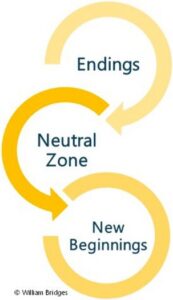
We tend to think of retirement as a single event, a moment in time. And from an earnings or occupational aspect that may be true. Yet, when we look to the work of those who specialise in change, we often see it described as a transition; not a clean break from a situation one day to a different situation the next. A state of shift and flux involving multiple decisions, emotions and perspectives.
The work of William Bridges is helpful here. It focuses on the internal psychological process people experience during change, rather than the external change itself. It outlines three stages of transition that are essential for leaders to manage during organisational changes to achieve successful adaptation. It is equally true for personal change and adaptation.
Let’s examine each stage when considering retirement:
Endings
A key part of retiring is moving away from a paid role that often comes with responsibility, status, professional pride and achievement, problem solving, helping others, and teamwork, as examples. While you may be looking forward to leaving some of this behind, some of it will be motivating and even part of who you are. Enjoy teamwork? Like a challenge? Identify with your profession? Leaving work becomes a huge set of psychological goodbyes.
New Beginnings
This is where any retirement planning usually focuses, especially the ‘enough’ question. Let’s move house, buy a car, do some travelling. It’s easy to focus on the early stages, but what about the next 15-20 years? What long term lifestyle do you (and your partner) want? What caveats, restrictions, boundaries, etc. need to be put in place? The reality is that much of this energy focuses on bucket list items. Beyond those, how will you replace the buzz some workdays gave you? What is the overall rhythm to your life? What will be your purpose, your daily or weekly routine, your ‘get out of bed’ factor, long after the house move and emptying that final suitcase? Picture your life 10 years from now – what is it like? What is it that actually makes you happy?
The Neutral Zone
Or as we sometimes call it, The Messy Middle, when many of the critical psychological realignments take place. This is the time between the old reality and sense of identity and the new one. At first most people feel elation as the restrictions of work schedules lift, the stress from deadlines fades and the freedom to have a lie in on a weekday takes hold. It is also when the doubt can creep in. You try joining a new club or hobby and, well, it wasn’t as much fun as you thought. You still don’t know exactly how life will be lived and you maybe miss a bit of the routine. You want to meet ex-colleagues, but they seem too busy. What was now a special treat at the weekend is no longer special. Everything can feel uncertain, up in the air. Things you thought you knew about yourself (or your partner) no longer seem to hold true. You might even be bored. This is an unsettling, but perfectly natural, stage of the transition into the next phase of your life. It’s the bridge between the old life and the New Beginnings.
You may have experienced career change before and be thinking that retirement is just another version of this. To some extent this is true; successfully navigating the ups and downs of job search, career shifts and learning a new role will have given you skills and experience you can draw on for the retirement transition.
Yet retirement is also very different. Most job searches come with criteria – the skills you want to use, the types of work you want to do. The next job usually comes with some guidelines – the main responsibilities, the goals, the scope of the role. Retirement comes with none of this. It is, in effect, a blank page. While this is an amazing opportunity, it can also feel like an existential threat. Choice is great, but too much choice can be paralysing. Instead, many people default to doing what others want them to do, whether that be partner, family or friends, leading to resentment or disagreement. As one client put it recently, “this is not the retirement I wanted”.
Retirement as phases
The truth is that retirement isn’t a single phase, it’s a series of life phases, each with an end, a beginning, and a messy bit in the middle. Just as some financial advisers recognise the “go-go”, “slow go” and “no go” phases, as specialists in retirement transition coaching, we recognise several phases too. Among them is the early ‘Honeymoon’ phase, typified by travel, housing adjustments and big projects. This is often followed 1-3 years later by a point of disenchantment – “Is this it?”, which we call the ‘Reset’; this is really where the true retirement begins. This ‘Reset’ is followed by the ‘Settled’ phase, which is usually the longest, perhaps 10-20 years. Inevitably there is a later life stage; for some quite short, for others a period of care. Each phase is a new transition, with psychological adjustments around identity, purpose and relationships.
The 8 Keys to successful retirement
Work is often an all-encompassing, meaningful and rewarding part of life so a holistic approach to planning for life in retirement is needed to support all the adjustments and challenges.
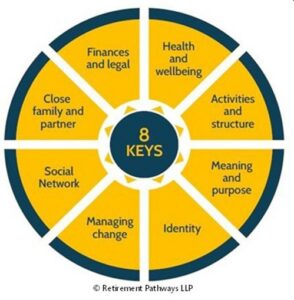
The impact of all the research and our own clients’ experiences led us to develop The 8 Keys to Successful Retirement©. Yes, finance is in there, although this segment is more about our relationship with money and the change of mindset from save to spend that many find so difficult. The other seven are predominantly addressing the psychological challenges, adjustments and opportunities that we know make a difference to how people experience retirement and their subsequent wellbeing.
Successful retirement planning addresses all these psychological and emotional aspects, way beyond “Can I afford to retire?”
If you would like to explore how well you are psychologically prepared for retirement, you can learn more about the Retirement Readiness Review, which is based on The 8 Keys. Please note that this is a separate service provided by Retirement Pathways and is not regulated by the Financial Conduct Authority.
Retirement as an opportunity for new beginning
It’s sometimes said that people spend more time planning a holiday or a wedding than their retirement.
Retirement used to be a time when you maybe followed a hobby, saw a few friends, took a few holidays. An extrapolation of your past life. With medical advances, many people will now have potentially 20+ active years to enjoy, and with a bit of planning you can now make retirement a time of great opportunity.
By putting in some thought and planning around all 8 Keys, you can design this period of your life to be the most rewarding. It’s not uncommon now for people to completely reinvent themselves, their lives, and sometimes their sense of identity. Some clients tell us they finally feel they can become the person they truly are, now they have left their work life and identity behind. David Bowie famously described ageing as “an extraordinary process whereby you become the person you always should have been”. With a bit of planning and thought, retirement can give you that opportunity.
Summary
A successful and fulfilling retirement is about so much more than the money. There are significant psychological and emotional adjustments to address; yes, there are things to let go; yes, there is uncertainty and experimentation; no, you won’t have all the answers on day one.
No two retirements will be the same; we are all individuals with varying needs and circumstances. Yet the factors that influence how well we experience retirement seem to be consistent.
The common denominator is planning, in advance. Even if you have no plans to retire yet, life has a way of catching up and a plan unused is better than one made in haste. Plan beforehand for success.
Retirement is an enormous opportunity, but you need to work at it. Like many things you’ll get more out of it the more you put into it. The best retirement is where opportunity meets readiness.
Please note:
Guest articles are provided for general information only and do not constitute financial advice. Any third party services mentioned are separate from Flying Colours and may not be regulated by the Financial Conduct Authority.
All information is correct at the time of writing and is subject to change in the future.

Anne Cannings
Anne spent 20 years in blue-chip companies before moving into coaching and consulting 25 years’ ago. Her experience covers HR, facilitation, executive coaching, and retirement planning.